HISTORY
Cockatiel – Nymphicus hollandicus

- Natural history
- Taxonomy
- Physical description
- Coloration
- Sexual dimorphism
- Diet
- Husbandry
- Behavior
- Normal physiologic values
- Anatomy/physiology
- Restraint
- Venipuncture
- Preventive medicine
- Injections
- Important medical conditions
- References
Cockatiels originate from the non-coastal regions of Australia. The free-ranging population is very large, and the IUCN lists this species’ conservation status of “least concern”. Cockatiels probably represent the smallest of the cockatoos, although there is some controversy surrounding this classification. Cockatiels are common as aviary birds and they make excellent pets.
ClassAves
OrderPsittaciformes
FamilyPsittacidae
Nymphicus hollandicus
The cockatiel is a small parrot (approximately 32 cm or 12.5 in) with an erectile crest and long retrices or tail feathers.
The standard or wild type cockatiel is predominately grey with yellow, orange, and white accents. Many color mutations exist including lutino, cinnamon, fallow, whiteface, pied, silver, olive, yellowcheek, and pearl.
Male cockatiels have yellow foreheads, throats, crests and cheek patches with orange ear coverts. Females have much less yellow and a barred pattern underneath the wings. Males have solid black plumage under their wings.
Sexual dimorphism is most obvious in the standard or wild type cockatiel. Until maturity at 6 months of age, coloration will resemble that of a female including yellow or white bars on the ventral surface of the wings.
- Cockatiels are granivores and frugivores. Free-ranging birds feed on grass seeds, grains, berries, and other fruits.
- Feed companion birds a varied diet to decrease the likelihood of obesity.
- Since psittacines hull seeds before ingestion, they do not require grit. In fact, some individuals will overeat grit when ill putting them at risk for impaction.
- All-seed diets are deficient in protein, vitamins, and minerals including calcium and vitamin A.
- Provide frequent water baths or showers to maintain normal skin/feather quality and to help control powder down dust.
- Cages should be at least 20-24 in (50-60 cm) long and wide.
- Perch diameter should be approximately 5/8 and 1.5 in (1.6-3.8 cm). Provide at least two perches placed far enough apart that the cockatiel can fly or glide. Sand paper perch covers are very abrasive to the feet, and are not recommended.
- Cage bar spacing of 0.5-0.75 in (1.3-1.9 cm) is recommended.
- Cockatiels are sociable birds.
- Cockatiels can have traumatic “night frights” which usually involve the bird thrashing around its cage in extreme fright.
- Foraging is an important part of normal daily parrot activity. Teach and encourage pet birds to play and forage.
Resting heart rate (beats/min)
Approximately 206
Respiration (breaths/min)
40-50
Temperature (average)*Approximately 41.8°C107.1°F
Body weight (g)
80-125
Average 90
Mean life span (years)
12-15
Up to 25y has been reported.Sexual maturity (months)6-12 Weaning age (days)47-52Parent-raised chicksFledgling (days)32-38 Mean Incubation (days)19-21Both the male and the female incubate the eggs.Number of eggs laid per clutch
3-8
Average 5
Weaning age (days)
42-52
Water intake (average)13.6 ml/day
Considerable individual variation exists
Target environmental temperature
Mimic natural environment.
Household temperatures of 70-80°F (21-27°C) are generally acceptable, however healthy birds can tolerate hot and cold temperatures.
*A routine avian exam does not include measuring body temperature.
Anatomic traits of Order Psittaciformes include:
- Communication of the right and left nasal sinus
- The only avian tongue with intrinsic muscles
- Simply syrinx
- Craniofacial hinge of beak is a synovial joint
- Ceca absent
- Gall bladder often absent
- Zygodactyl foot: two toes pointed backward and two pointed forward
Cockatiels may be restrained by holding the head between index and middle fingers. Support the body with the palm of the hand as well as the thumb and little finger.
Use a 27-gauge needle and 1 to 3-mL syringe to draw blood from the right jugular vein. Collection of up to 1% of body weight is acceptable in healthy patients.
- Obtain a complete history and perform a thorough annualphysical examination.
- Establish baseline data with regular clinical testing (complete blood count, protein electrophoresis, and plasma biochemistries.
- Ensure proper nutrition and husbandry.
- Recommend quarantine of newly acquired birds.
- Perform additional testing for select diseases based on history and physical exam findings: avian polyoma virus, psittacosis.
- Determine the origin and history of newly acquired sick birds to contain and prevent further spread of disease.
Intramuscular(IM)
Reasonably safe, most accurate.
Inject middle of muscle mass.
Ideal location –Pectoral muscle mass
Subcutaneous(SQ)
Large volumes can be injected, poor absorption.
Location: Inguinal or precrural fold
Effective, narrow safety range.
Right jugular vein or brachial vein is most commonly used.
Alternative option: superficial metatarsal vein.
Infectious Diseases
- Chlamydophilosis
- Giardiasis
Non-Infectious conditions
- Candidiasis
- Feather cysts
- Chronic egg laying, egg binding, dystocia and other reproductive problems
Lutino cockatiels are at increased risk for health problems.
Adams M, Baverstock PR, Saunders DA, etal. Biochemical systematics of the Australian cockatoos (Psittaciformes: Cacatuinae). Australian J Zool 32(3):363-377, 1984.
Beynon P (ed). BSAVA Manual of Psittacine Birds. Ames, Iowa: Iowa State University Press, 1996. 7-9, 37. Print.
Blanchard S. Companion Parrot Handbook. Alameda, CA; PBIC, Inc; 1999. Pp. 70, 188, 237.
Carpenter J (ed). Exotic Animal Formulary. 3rd ed. St. Louis, MO; Elsevier Saunders; 2005. Pp. 278-279.
Convention on International Trade in Endangered Species of Wild Fauna and Flora. Appendices I, II, and III. Valid from Apr 27, 2011. Available at: http://www.cites.org/eng/app/appendices.php. Accessed June 8, 2011.
Finkelstein A. Normal cloacal temperatures in multiple avian species. Proc Annu Conf Assoc Avian Vet; 2004. P. 383.
Doneley B, Harrison GJ, Lightfoot TL. Maximizing information from the physical examination. In: Harrison GJ, Lightfoot TL (eds). Clinical Avian Medicine. Palm Beach, FL: Spix Publishing; 2006. P. 173.
Harcourt-Brown N, Chitty J (eds). BSAVA Manual of Psittacine Birds, 2nd ed. Quedgeley, Glouchester: British Small Animal Veterinary Association; 2005. Pp. 4, 28.
Harrison GJ, Harrison LR. Clinical Avian Medicine and Surgery, Appendix 4, Philadelphia; W.B. Saunders; 1986. P.662.
Koustos EA, Matson KD, Klasing KC. Nutrition of birds in the order Psittaciformes: a review. J Avian Med Surg15(4):257-275, 2001.
IUCN 2010. IUCN Red List of Threatened Species. Version 2010.4. IUCN Red List Web site. 2010. Available athttp://www.iucnredlist.org/. Accessed June 12, 2011.
Lafeber Company. The Cockatiel. Lafeber Pet Birds Web site. Available at: http://lafeber.com/pet-birds/species/cockatiel/ Accessed May 16, 2011.
Low R. Parrots in aviculture: A photoreference guide. Pickering, Ontario; Silvio Mattachione & Co; 1992. P. 82.
Morgan D. Bird Care. Neptune City, NJ: TFH Publications; 2005. Pp. 15-16, 17-18.
O’Malley B. Clinical Anatomy and Physiology of Exotic Species. Edinburgh: Elsevier Saunders; 2005. Pp. 156-157.
Tully TN. Birds. In: Mitchell M, Tully TN (eds). Manual of Exotic Pet Practice. St. Louis, MO: Saunders; 2008. Pp. 270-271, 276.
 Print Friendly


Select LanguageAfrikaansAlbanianArabicArmenianAzerbaijaniBasqueBelarusianBengaliBosnianBulgarianCatalanCebuanoChinese (Simplified)Chinese (Traditional)CroatianCzechDanishDutchEsperantoEstonianFilipinoFinnishFrenchGalicianGeorgianGermanGreekGujaratiHaitian CreoleHausaHebrewHindiHmongHungarianIcelandicIgboIndonesianIrishItalianJapaneseJavaneseKannadaKhmerKoreanLaoLatinLatvianLithuanianMacedonianMalayMalteseMaoriMarathiMongolianNepaliNorwegianPersianPolishPortuguesePunjabiRomanianRussianSerbianSlovakSlovenianSomaliSpanishSwahiliSwedishTamilTeluguThaiTurkishUkrainianUrduVietnameseWelshYiddishYorubaZulu
Powered by  Translate

Emeraid Herbivore 300 g (10 oz) tub
Developed by an expert panel including exotic animal and emergency clinicians, nutritionists, and Dr. Lafeber. Emeraid Herbivore is the first elemental diet designed to meet the needs of the critically ill herbivore. Emeraid Herbivore is a part of theEmeraid Nutritional Care System, which is divided into three categories: Carnivore,Herbivore, and Omnivore. By using these products singly or in combination, acutely ill exotic animals can benefit from Emeraid feedings.
New Guest Register | Login
Lost Password? | Log Out
Caring and working for the health of animals.
COCKATIEL BABY GROWTH STAGES 


HOW TO BREED LOVEBIRD
byAZAANATHAR
Welcome to tips for beginning breeders. This section of the site has been designed with novice in mind, though even experienced breeders can probably find something of interest here. The information here is based primarily on my experience with peachfaced lovebirds, though many of the ideas and principles will apply equally well for the other common species.

Spoon-feeding baby Nyasa lovebirds
I’ve organized this section by general topics. You can read through each one in the order they are listed, or simply pick and choose the ones that interest you. If you are totally new to breeding birds, I would strongly recommend that you read the first article "Do I really want to do this?" before moving on to other topics.
These articles are built around the way I house, care for, and breed my birds. Many breeders feel that their system is the only "right" way to do things, and to some extent I am guilty of that prejudice as well. However, I know breeders who manage aviaries which are very different from mine, and have terrific success. Sometimes these differences are based on simple preference, sometimes on the facilities, budgetary considerations, or simply the location. My experience has been working with a mid-sized indoor aviary in the American Midwest. A breeder managing a large outdoor aviary in Florida, California, or elsewhere in the world will certainly enjoy advantages, and encounter problems, very different from mine.
There is an enormous amount to learn about raising lovebirds, but you don’t need to learn it all at once. There is a lot of material here for you to sift through, and I hope to expand this section from time to time, as there is so much to cover, and even after eight years of breeding lovebirds I am still learning new things all the time. You can’t possibly learn everything there is to know before you begin, but it definitely helps to learn all you can
LOVEBIRD BABY GROWTH STAGES
Lovebird babies - growth progress & co-parenting (picture heavy)
Well I believe eggs are done hatching now. We ending up with 4/6, not bad for their first clutch, I don't think. I candled the last 2 eggs, and although I have no idea what I'm doing when it comes to candling, egg #4 looks totally empty... egg#6 I had a harder time telling. I think it's empty too. I will leave them in there for a little while longer and then I'll probably remove them so they don't get broken and make a mess.
The four babies are doing great so I thought I'd share lots and lots of pictures. They're freaky naked pink dinosaur-look is really starting to grow on me 
Here is Chick #1 (11 days old), who opened his/her eyes a few days ago. Something about the fact that he can look me in the eye now makes him 100X cuter.


Here is Chick #2 or 3 (8 or 9 days old), I can't tell them apart because they were only hatched a day apart and look nearly the same (to me). I think this one is the third because he isn't as dark as the other, although they're practically the same size.

And Chick #2... or 3 (8 or 9 days old). Ack.

And finally, Jellybean (4 days old)! He's so darn tiny. And the only one with an official name so far 


Rafiki continues to amaze me with her total acceptance of my poking around in the nestbox. When I knock and open it now she steps to the side and she doesn't mind me picking the babies up. I have been 'borrowing' the oldest one for short spans of time to get started with socializing as I'm taking the 'co-parenting route'. Mom & dad get to feed the babies but I will be taking them out and playing with them so they'll be tame.
So far I've mostly been spending time with Chick#1 and I'm finding the whole experience really cool. He snuggles right up in my fingers and seems quite comfortable while I blabber on to him about nonsense. He's a pretty good listener.
I'll be posting updates on how things go in the future 


- If this is your first visit, be sure to check out the FAQ by clicking the link above. You may have to register before you can post: click the register link above to proceed. To start viewing messages, select the forum that you want to visit from the selection below.
Results 1 to 24 of 24
Thread: Lovebird babies - growth progress & co-parenting (picture heavy)
-
06-15-2011, 03:48 PM#1
AZAANATHAR

Egg's Cracking...
 NameAZAANATHARJoin DateFeb 2010LocationToronto, CanadaPosts326Thanks0Thanked 4 Times in 4 Posts
Lovebird babies - growth progress & co-parenting (picture heavy)
Well I believe eggs are done hatching now. We ending up with 4/6, not bad for their first clutch, I don't think. I candled the last 2 eggs, and although I have no idea what I'm doing when it comes to candling, egg #4 looks totally empty... egg#6 I had a harder time telling. I think it's empty too. I will leave them in there for a little while longer and then I'll probably remove them so they don't get broken and make a mess.
The four babies are doing great so I thought I'd share lots and lots of pictures. They're freaky naked pink dinosaur-look is really starting to grow on me
Here is Chick #1 (11 days old), who opened his/her eyes a few days ago. Something about the fact that he can look me in the eye now makes him 100X cuter.
Here is Chick #2 or 3 (8 or 9 days old), I can't tell them apart because they were only hatched a day apart and look nearly the same (to me). I think this one is the third because he isn't as dark as the other, although they're practically the same size.
And Chick #2... or 3 (8 or 9 days old). Ack.
And finally, Jellybean (4 days old)! He's so darn tiny. And the only one with an official name so far
Rafiki continues to amaze me with her total acceptance of my poking around in the nestbox. When I knock and open it now she steps to the side and she doesn't mind me picking the babies up. I have been 'borrowing' the oldest one for short spans of time to get started with socializing as I'm taking the 'co-parenting route'. Mom & dad get to feed the babies but I will be taking them out and playing with them so they'll be tame.
So far I've mostly been spending time with Chick#1 and I'm finding the whole experience really cool. He snuggles right up in my fingers and seems quite comfortable while I blabber on to him about nonsense. He's a pretty good listener.
I'll be posting updates on how things go in the future


Budgie History
Welcome! Here you will learn all about budgie history, whether you are a beginner or a experienced owner!
A little history:
Budgies first originated in Australia. They are today found in no other place in the wild. The “normal” color for budgies is a bright green with a yellow head. These are and were always the only color budgie ever found in the wild. These colors help them camouflage in the leaves. Other color mutations were quickly seen and eaten before they had the chance to pass on their genes.
Budgies have two subspecies: the American Budgie and the English Budgie. It may not seem like it, but these two species are different in a numerous number of ways. The American budgie is slightly larger than the wild Budgie, but that is the only real difference between them, other than the fact that the American Budgie has more color mutations. The English Budgie is much larger than both other types of budgies. For a first, it has a larger forehead. Also these live from five to seven years with good care instead of fifteen years or more. But both the American and English budgie make very good companions.
The word “Budgie” is a shorter version of the actual name “budgerigar” which in a ancient Australian language means “good to eat” The Latin name of this specie of parrot is Melopsittacus undulatus. There are over five million individuals, and only of the wild ones. Budgies are found all over Australia, mostly deserts, farmlands, and woodlands. There are no actual threats, though large numbers of wild budgies die during drought. But budgies can very easiky reproduce, and that makes up for the drought loss. Budgies are sometimes found in huge flocks, flocks that can cloud up the skies. Budgies like to gather in even bigger flocks near or at watering holes. Budgies are normally very active during the day.
HOW TO BREED BUDGIES
How to Breed Budgies
-
byAZAANATHAR
Six Parts:Selecting the breeding pairSetting up the breeding areaAdding a nest boxBreedingCaring for the chicksFledging time
Budgie breeding may sound like a great hobby and it is! However you need lots of knowledge! You also need to make all of the budgies happy and healthy to make a happy family.
Part 1 of 6: Selecting the breeding pair
-

1
Find a suitable breeding pair. The pair must be older than 12 months old but younger than four years old. They should be healthy and have no deformities such as splayed legs or similar.- If you want eggs to eat, called infertile eggs, do not get a male budgie; just a female one and will lay eggs that you can eat.
-

2
Ensure that the breeding pair eats a healthy, balanced diet consisting of a good quality seed, fresh fruits and vegetables, grains, etc. -

3
Wait for the budgies to adjust to their new surroundings for four weeks if they were purchased recently, and let them bond.


Part 2 of 6: Setting up the breeding area
-

1
Use a suitable cage. Choose one that is approximately two feet wide. The cage should be wider than it is tall (budgies fly horizontally), square-topped and have at least three doors: one for the food dish, on for the water dish, and one for you to easily access the cage. You might need to cut a small hole in the cage for the nest box (see below for a nest box). -

2
Get all the items needed. You'll likely need: perches, a few toys for the male budgie, (do not put the toys to close that can cause the male to get hurt) ,feeder and water dishes, a cuttle bone, liquid calcium, or grit (two of these calcium sources at least), a mineral block (optional), extra food and water dishes to put on the ground when babies fledge, baby budgie formula, a small syringe, and a place for an orphaned baby budgie just in case. -

3
Find a suitable avian vet (specializes in birds) if you haven't already done so.Keep all details, including a phone number, close at hand. You never know when something will go wrong, so when it does, call.


Part 3 of 6: Adding a nest box
Nesting budgies need a cozy and comfortable place to nestle into.
-

1
Buy or make a reasonably sized nest box. Good dimensions are: (9" (H) X 6" to 8" (W) X 6" to 7"(D) with an entry hole of 2 inches diameter). -

2
Make a budgie coconut husk nest box. If you like, make your own nest box from coconut husks. A coconut husk makes an ideal choice as it is not only snug but also offers something to bite on should the budgie get such a notion.- Locate three coconut husks. They need to be roughly the same size.
- Drill some holes in one of the husks. Make a hole in the top part of the husk, a hole on one side and another hole on the other edge.
- Repeat for the other two husks.
- Draw the husks together using bird-safe wire or string. Thread through the drilled holes.
- Make a hanger hole at the front of the husk. Or, make it wherever it seems appropriate.
- Hang the husk in the breeding cage.


Part 4 of 6: Breeding
-

1
Wait. Do not disturb the budgies. They will do their "thing" in their own time, but disturbing them and constantly hovering over them is not going to help. You may not catch them mating, but if you do, let them be. (If not, the female/hen will tell the male to get off and the mating will stop.) -

2
When eggs come about, wait until each one is five days old and candle them.You can find candling steps online. Be very gentle and avoid touching the eggs. However, be aware that this step is optional; it's recommended that you do your research first before deciding.


Part 5 of 6: Caring for the chicks
-

1
Check regularly. The chicks will eventually hatch so it is very important that you check the nest box daily. Try to do this when the mother bird is out eating. Block the nest box entrance temporarily (for example, use a cut of newspaper). This is so the mother bird doesn't burst in and bite you.- Gently check the chicks over for injury, seeds/air bubbles in the crop (the sack at the base of the chick's neck).
- Check that the crop is full (bulging).
- Make sure no food is stuck inside the top of the upper mandible (top of the beak). If there is food, gently pick it away with the end of a matchstick or the quill-end of a feather.
- Clean off poop and/or food from around the toes, beak, eyes, and other body parts with a soft, damp, and warm cloth.
- Remove any dead bodies.

-

2
Clean up! Chicks also mean poop, so the nest box must be cleaned out regularly. When the hen is out eating, remove the chicks and eggs to a small container lined with soft paper towels. Scrape out the soiled bedding and scrape away wet poops from the bottom of the nest box, then replace the nesting materials with fresh stuff. Gently replace chicks and eggs back. Make sure to be as quick as possible. -

3
When chicks reach three weeks old, or close to that, provide them with one millet spray each day. Simply put it in the box. The mother bird will nibble at it and immediately regurgitate this for her chicks. The babies may also take a bite or two, mimicking their mother. This helps with weaning later on as chicks recognise the seed as being food straight away.


Part 6 of 6: Fledging time
-

1
When chicks finally fledge at the age of 28 - 35 days old, put a dish of seed and another separate dish of shallow water at the bottom of the cage. Though the father bird feeds them entirely at this stage, you want to encourage them to start eating solid food as soon as possible. It is also a great idea to provide a bowl of chopped fresh fruits and veggies - fledglings love to explore and try new things! -

2
Provide chicks with a small hut on the ground so they can shelter from grumpy Mama. If you allow the hen to lay another round of eggs, she will often become aggressive towards the chicks. Since you want chicks to stay with the male bird as long as possible, give them a clean, empty upside-down ice-cream container with a door cut out of it, or a hamster igloo which you can purchase from the pet store. The baby will shelter in this.- Make sure that baby birds don't stay in there all day, Maybe take it out for a few hours a day so the baby birds can explore the cage and remember to eat and drink.
-
3
Remove the nest box. You can let the hen go on for a second round but often it causes a lot of stress on the breeding pair. When the last chick fledges, remove the nest box immediately and seal the hole where the nest box was. Perhaps separate the mother bird from the father bird and chicks, as she may be a bit mean to her babies. -

4
Name your baby birds. You may not be able to know the gender of a budgie baby but when it is around 1 month, you can give it a appropriate name. Guess what, you made a budgie happy family!


Add your own method
Tips
- Feed fruits and veggies daily, especially when chicks fledge.
- Provide a cuttle bone and mineral block.
- Provide plenty of toys for them.
Warnings
- Don't let budgies breed in nest boxes that are too small or anything not meant for breeding in. If eggs end up in a Snuggle Hut, log, cardboard box or the like that you put in the cage, replace with fake eggs and addle the real ones (shake them up fast).
- Never colony breed. Colony breeding is when you breed more than one pair of birds in a single cage at a time. This often results in nest raids, dead/injured chicks, broken eggs, injured/fighting/dead parents, etc. Although wild budgies breed in colonies, they have many, many trees and hollows to choose from for nest sites, and the whole sky to fly around in.
Things You'll Need
-
A nest box (if making the coconut husk one: * 3 coconut husks, bird-safe wire or string, drill
-
A healthy, bonded pair of budgies
-
A large cage with the correct features
-
Extra food/water dishes to put on the ground
-
Suitable budgie toys
-
Hand-rearing formula, a warm safe place to keep orphaned baby budgies, and a syringe
-
The number of your favourite avian vet & contact details of the clinic
-
Space
-
Extra money ($500 + for each pair would be ideal, if something does go wrong, it is often very expensive)


BUDGIES GROWTH STAGES
Keeping Budgies: From an egg to a fledgling
This is a simple little story of how a budgie egg is laid and goes on to become a fledgling ready to leave the nest.
It all starts, of course, with the male and female both being in breeding condition and mating.
The first egg is usually laid around 10 days after a successful mating and then every other day until the clutch is laid. The mother sits in the nestbox most of the time and the father feeds her. At between 18-23 days after the first egg is laid, the chick hatches.


The chick then grows rapidly as you can see by the following pictures. These pictures show the eldest chick on days 3, 7, 10 and 12 respectively.


By the time the chick is 2 weeks old he is starting to feather up nicely. He looks kind of prickly and weird to begin with, but soon starts to look like a 'real' budgerigar. He looks a lot different to his younger siblings and is very curious about everything that goes on around him. You can see him in the following photos at 13, 14, 16 and 22 days old.


At the age of 23 days, the chick has most of his feathers and only some small bits of down left. at 26 days you can barely notice any down at all on him. By the time he's 29 days old the down really doesn't show much at all and he is ready to start exploring the world outside the nest box. At 31 days he pretty much looks just like the older budgies you would see in a pet shop.


The chick is now old enough to start thinking about leaving the nestbox for good. A chick will normally do that somewhere between 28-35 days of age. He will then get fed by the male budgerigar until he's about 38-42 days, at which time you will be able to see that he's becoming very independent and managing to eat and drink on his own. When the budgie chick is around 6-8 weeks, you can start thinking about getting him a cage of his own, letting him join the gang in the aviary if you have one, or sell him if that's what you choose to do. Never ever sell or give away a baby budgerigar before you know for definite that he can feed and drink without his parents help.
===============Resource Box===========
AZAANATHAR keeps and breeds pet budgerigars.
Visit Adorable Budgies for information, pictures and forum
http://adorablebudgies.co.uk
====================================
(this article reserved by AZAANATHAR

ZEBRAFINCHES
The zebra finch (Taeniopygia guttata) (formerly Poephila guttata),[2] is the most common estrildid finch of Central Australia and ranges over most of the continent, avoiding only the cool moist south and some areas of the tropical far north. It can also be found natively in Indonesiaand East Timor. The bird has been introduced to Puerto Rico, Portugal, Brazil and the United States.
Contents
[hide]
- 1 Habitat
- 2 Life cycle
- 3 Subspecies
- 4 Song and other vocalizations
- 5 Diet
- 6 Breeding
- 7 References
- 8 External links
Habitat[edit]

Adult male at Dundee Wildlife Park, Murray Bridge, South Australia

Domesticated zebra finch, southern France

Captive male

Captive female
.jpg)
Male in Western Australia, Australia
Zebra finches inhabit a wide range of grasslands and forests, usually close to water.[3] They are typically found in open steppes with scattered bushes and trees, but have adapted to human disturbances, taking advantage of human-made watering holes and large patches of deforested land. Zebra finches — including many human-bred variants to the species — are widely kept by genetic researchers, breeding hobbyists andpet owners.
The zebra finch breeds after substantial rains in its native habitat, which can occur at any time of the year. Birds in captivity are ready to breed year-round. Wild birds are adaptable and varied in their nesting habits, with nests being found in cavities, scrub, low trees, bushes, on the ground, in termite hills, rabbit burrows, nests of other birds, and in the cracks, crevices, and ledges of human structures. Outside of the breeding time, brood nests are constructed for sleeping in.
Zebra finches are distributed over much of Australia and the Lesser Sunda Islands (Nusa Tenggara), which are north-west of Australia.
Life cycle[edit]
The life expectancy of a zebra finch is highly variable because of genetic and environmental factors. The zebra finch may reach up to five years in its natural environment. If they are kept caged, they normally live for 5 to 7 years but may live as long as 12 years,[4] with an exceptional case of 14.5 years reported for a caged specimen.[5] The greatest threats to zebra finch survival are predation by cats and loss of natural food.[3]
Subspecies[edit]
The two subspecies are:
- Taeniopygia guttata guttata, the Timor zebra finch, extends from Lombok in the Lesser Sunda Islands or Nusa Tenggara in Indonesia to Sermata, in addition to coastal areas around the continent of Australia.
- Taeniopygia guttata castanotis is found over the wide range of continental Australia.
The Australian race is sometimes split as chestnut-eared finch (Gould, 1837), Taeniopygia castanotis.
The morphological differences between the subspecies include differences in size. T. g. guttata is smaller than T. g. castanotis. In addition, the T.g. guttata males do not have the fine barring found on the throat and upper breast of T.g. castanotis, as well as having small breast bands.
Song and other vocalizations[edit]
Zebra finches are loud and boisterous singers. Their calls can be a loud beep, meep, oi! or a-ha!. Their song is a few small beeps, leading up to a rhythmic song of varying complexity in males. Each male's song is different, although birds of the same bloodline will exhibit similarities, and all finches will overlay their own uniqueness onto a common rhythmic framework. Sons generally learn the song of their fathers with little variation. Songs may change during puberty, but afterwards they are locked in for the life of the bird.[6] Scientific research at Japan's RIKENinstitute has suggested that singing to females is an emotionally rewarding experience for male zebra finches.[7]
Male zebra finches begin to sing at puberty, while females lack a singing ability.[4] This is due to a developmental difference, where in the embryo, the male zebra finch produces oestrogen, which is transformed into a testosterone-like hormone in the brain, which in turn leads to the development of the nervous system for a song system. Their songs begin as a few disjointed sounds, but as they experiment, they match what they sing to the memory of their fathers' song, and they rapidly mature into full-fledged songs. During these formative times, they will incorporate sounds from their surroundings into their songs, also using the songs of other nearby males for inspiration.
Male finches use their songs, in part, as a mating call. The mating act is usually accompanied by a high-pitched whining sound. They will also exhibit a hissing sound when protecting their territories.
Because zebra finch males learn their songs, they are often used as avian model organisms to investigate the neural bases of learning, memory, and sensorimotor integration. The zebra finch genome was the second bird genome to be sequenced, in 2008, after that of thechicken.[8] Their popularity as model organisms is also related to their prolific breeding, an adaptation to their usually dry environment. This ability also makes them popular as pet songbirds.
Diet[edit]
Zebra finches, like most estrildid finches, are primarily seed-eating birds, as their beaks are adapted for dehusking small seeds. They prefer millet, but will consume many other kinds of seeds, as well. While they prefer seeds, captives will also eat egg food. They also readily consume fresh foods, such as small bits of chopped lettuce, apples, and grapes. They are particularly fond of spray millet, and one or two of these small birds will eat a spray millet stalk within a few days. Zebra finches are messy and voracious eaters, typically dropping seeds everywhere. This behaviour spreads seed around, aiding in plant reproduction. The availability of water is important to this bird's survival, therefore the zebra finch will drink often when water is available and enjoys taking bird baths in a small, shallow bowl. A typical zebra finch may be plump, because it eats quite often throughout the day, but an overweight bird needs more exercise, not less food. Finches should always have access to fresh food and water.[3]
Breeding[edit]

This article contains instructions, advice, or how-to content. The purpose of Wikipedia is to present facts, not to train. Please help improve this article either by rewriting the how-to content or by moving it to Wikiversity, Wikibooks or Wikivoyage (September 2009)

This section needs additional citations for verification. Please help improve this article by adding citations to reliable sources. Unsourced material may be challenged and removed. (November 2009)

Female with two juveniles in New South Wales, Australia

Juvenile zebra finch
In the zebra finch, sudden bursts of gathering behaviours signal that a pair is ready to nest.[4] The pair will pull strings or plant leaves they can reach, and if no materials are available to gather, they will use feathers and bits of seed husks. Alfalfa or timothy hay is an acceptable nesting material, as it is closest to what is readily available in the wild. Any item they can use to build a nest will be deposited in a corner of the cage floor, or in their food dish. When these behaviours are noticed, a mating pair should be provided with a sturdy wicker nest about the size of a large apple or orange. This nest should always be placed in the highest possible corner of the cage, opposite the food dish, but near the normal night perch. Nesting finches will abandon a perch if it is across the cage, with the male showing he prefers to sit atop the nest while the female lays. During the nest building, however, both will spend the night cuddling inside the nest.[4]
When they accept the nest shell and begin using it each night, they should be provided with an ample supply of very soft bits of short string and leaves. They prefer items only a couple of inches long and will use nearly any type and colour of soft material; longer bits of string or nesting material can tangle around the finches or nestlings and cause distress that will lead to strangulation or even death. The nest shell will be packed with everything they can reach for at least a week before laying begins.[4]
The number of eggs ranges from two to seven eggs per clutch, with five being the most common number.[9] In captivity, some birds lay larger clutches.
Males and females are very similar in size, but are easily distinguished from one another, as the males usually have bright orange cheek feathers, red beaks (as opposed to the orange beaks of females), and generally more striking black and white patterns.[3] The beak is sometimes the only way to tell the gender of a zebra finch, as sometimes the orange cheek colouring is faded or non-existent. Offspring from a similarly coloured nesting pair may sometimes vary from the parents' colouration, with nestlings varying from plain grey to completely white. These variations are usually due to mixed breeding between finch types somewhere down the family line, especially in pet store birds. However, the orange cheeks are a stubborn indication that a young zebra finch is indeed a male and the cheeks begin to appear when the young are about two months old. Young zebra finches will also have black beaks, with the colouring coming in at puberty, though it begins changing at age one month.
The chicks will hatch according to the laying time of each egg. It is common to have one or two eggs remaining unhatched as the parents begin the task of feeding the nestlings. Though it is preferable to leave nests alone after the egg-laying begins, once hatching begins, a breeder might find it useful to make daily checks into the nest to correct problems early, such as larger chicks sitting on and smothering smaller ones, thus increasing the number of chicks that eventually fledge. The time from laying until a fledgling adventures outside will vary with each clutch, but generally good eggs will hatch within 14 to 16 days of laying and young will begin to venture out within about three or four weeks of hatching, and will look full-grown in about three months. Breeding age is six or more months. Zebra finches are usually excellent parents and will readily take turns sitting on the nest and bringing food to the young.
While the female is laying, only her mate will be allowed in the nest. Allowing the pair to start a new family while the first clutch is still in the cage will overly stress all the birds in the family. The male of the breeding pair will not allow any other birds near the nest while eggs are being laid. It is advised that newly fledged birds be removed and placed into a separate enclosure to prevent aggressive actions of the adult male who will likely try to beat up younger birds which are seen as competition for the female's attention.


ZEBRA FINCHES BABY GROWTH STAGES

Step 1: First day, Small and very vulnerable. (Hatchling) http://images.sciencedaily.com/2006/09/0...
Step 2: Doubled in size (second day)
Step 3: Day 3-5 Will start to make a quiet "ff ff" sound for food. (Nestling)
Step 4: At around 1 week their eyes will open. (Will start to grow feathers)http://www.efinch.com/Gape/mgf_top.jpg
Step 5: Chicks will continue to grow and more feathers will appear... http://farm3.staticflickr.com/2023/17984...
Step 6: 3-4 weeks of age chicks will fledge from the nest. (Fledgling)
Step 7: Parents will continue to feed the chicks for another week or so until they eat on their own at about 4-5 weeks of age. The chicks are greyish in colour when they fledge. (Juvenile)http://i286.photobucket.com/albums/ll106...
Step 8: 6 weeks of age Chicks will start to lose their 'juvenile' colour and grow adult feathers. Their beaks will turn orange. They will be feeding themselves and become independent. (adult)http://l.yimg.com/ck/image/A1154/115445

SILVER DIAMOND DOVE GROWTH STAGES
Growth of a Diamond Dove Baby
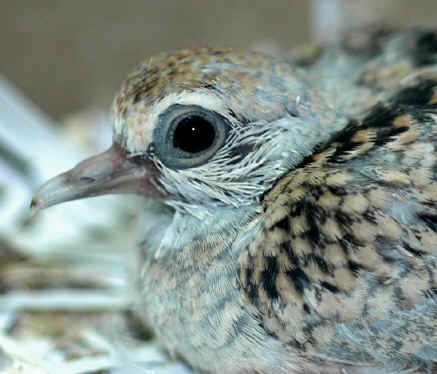
Baby June
Age 10 days
Hatched June 24, 2007
Baby Development
Many visitors to this site have asked questions about the growth and development of young babies. This section now includes daily photographs and length measurements of a diamond dove baby for the first three weeks of it's life.
Background of Parents
The male, Australia, was purchased from a breeder in New Mexico and was received in February 2006. He was banded and was two years old when received. The male was purchased as a caretaker bird for China a very old hen who had lost her mate and her two best friends, but China died two weeks before the male arrived. (See the page A Tribute to China). The male lived without a cage for a year and a half and roosted on some oak branches located near the bird cages. He always picked the same spot allowing his stools to fall on sheet plastic purchased to protect the furniture. He obtained his food and water by going in open cages.
Tasmania was purchased as a mate for Australia in December 2006. Although Tasmania was interested in Australia from the start, she was rejected by him as an intruder. After a few months passed then Australia did become interested in her but by then she had become angry with him and resisted his advances. In February 2007 a cage became free when the white Eurasian collared dove left for another home and Tasmania moved into the cage and took over the empty nest immediately. She laid her first two infertile eggs soon after she had the nest. Australia was put in the cage after a week but they fought so he was removed. Several trials were attempted and then one day we saw Tasmania shake her wings when Australia passed by on the outside. The cage was opened, he went in and a sometimes violent courtship followed. After some time Tasmania laid two eggs and they incubated them. Both eggs were fertile but the embryos died just before the end of the incubation period. After some time a second clutch was laid and and this page is the story of the second baby in that clutch. He hatched out on June 24, 2007.
Growth Records
The graph below displays the daily growth records from age 0 to age 21 days which is about the time most babies are allowed to stay in the parent's cage
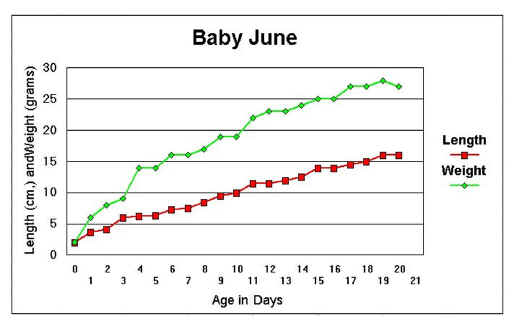
Do note the change in size of the baby is not well represented in the photos as the photos at the younger ages were taken closer to the dove than those taken at the older ages. This procedure provided a greater amount of detail in the younger bird. However the length of the baby is given for each day
Day 1June 24, 2007
The first baby of this clutch was too weak to feed and tossed form the nest. The second baby hatched out on the morning of July 24, 2007. The parents kept it covered except for feeding. Day 2June 25, 2007
The parents kept the baby covered except for feeding. Day 3
June 26, 2007
The baby sometimes opened its eyes. The parents again keep the baby covered except for feeding.
Length: 4.1 centimeters (est.)
Weight: 8 grams (est.)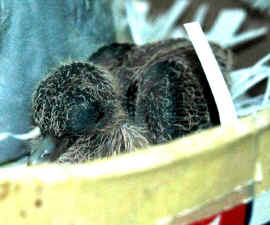 Day 4June 27, 2007
The babies eyes are now open except when sleeping after being fed. Pin feathers can be seen over most of the body
Length: 6.0 centimeters.
Weight: 9 grams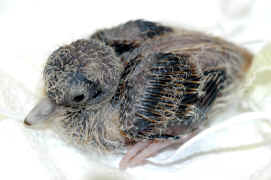 Day 5June 28, 2007
The pin feathers have grown longer and the feather vanes can bow be seen at the end of the pin feathers.
Length: 6.2 centimeters.
Weight:14 grams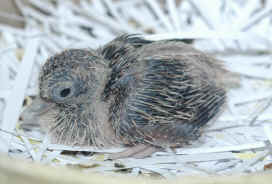 Day 6June 29, 2007
Most of the wing feather vanes can now be seen, but the head is still covered with pinfeathers. The dark colored primary flight feathers are now visible. The tail feathers are just starting to grow out.
Length: 6.4 centimeters.
Weight: 14 grams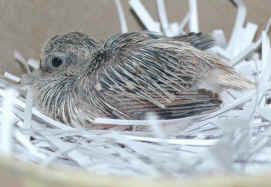 Day 7June 30, 2007
The baby is left uncovered all the time. He is fairly inactive and sleeps after being fed. Does not beg for food.
Length: 7.3 centimeters
Weight: 16 grams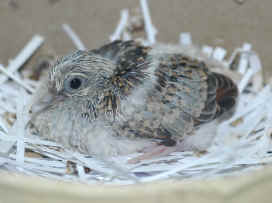 Day 8July 1, 2007
The baby now has some fully opened
feathers on his head. He is now very active and is walking around the nest, sometimes looking over the edge. Preens his own feathers for the first time.
Length: 7.5 centimeters
Weight: 16 grams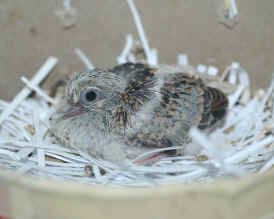 Day 9July 2, 2007
The baby continues to be active and often begs for food. The tails has extended the bird's length another centimeter .
Length: 8.5 centimeters
Weight: 17 grams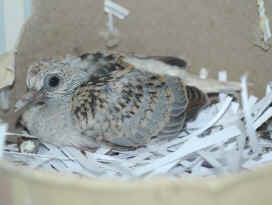 Day 10July 3, 2007
Frequently begs for food. Continues to be very active.
Length: 9.5 centimeters
Weight: 19 grams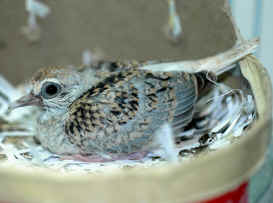 Day 11July 4, 2007
Took out of nest to measure and put on carpet. The baby flew up about three feet and then across the room to the couch.
Length: 10 centimeters
Weight: 19 grams 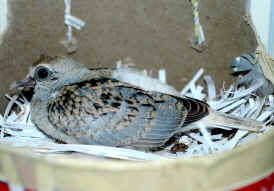 Day 12July 5, 2007
Now flies around cage, chasing parents to ask for food. There is some pecking of seed on the cage floor but does not eat any.
Length: 11.5 centimeters
Weight: 22 grams
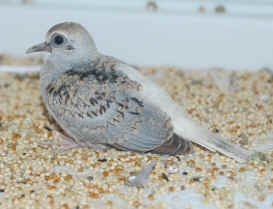 Day 13July 6, 2007
Roosted on bar last night with parents.
Continues to peck at seed but does not eat any, continues to chase parents for food.
Length: 11.5 centimeters
Weight: 23 grams 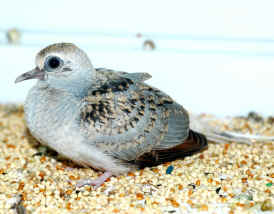 Day 14July 7, 2007
Allowed to go to the sun window with the other birds. They taught the baby how to peck bread. Then soon he was able to peck some seed. Made its first peeps.
Length: 12 centimeters
Weight: 23 grams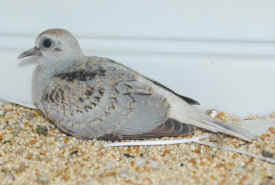 Day 15July 8, 2007
Continued to try and peck seed, mother preened the baby, slept with parents on the perch at night.
Length: 12.5 centimeters
Weight: 24 grams 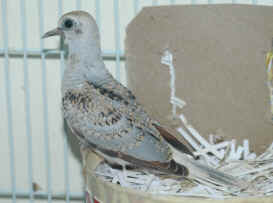 Day 16July 9, 2007
Pecking bread and cheese, trying to
peck seed, starting to have success,
roosted on perch with both parents at
night.
Length: 14 centimeters
Weight: 25 grams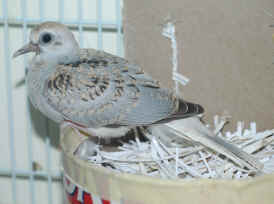 Day 17July 10, 2007
The female laid her first egg of the next
clutch late the previous evening. Baby
now helps with the incubation of the new egg. Sometimes the baby is left alone with the egg.
Length: 14 centimeters
Weight 25 grams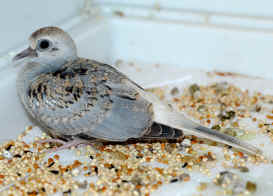 Day 18July 11, 2007
Now able to peck seeds very well. Often sits on the egg with the mother.
Length: 14.5 centimeters
Weight: 27 grams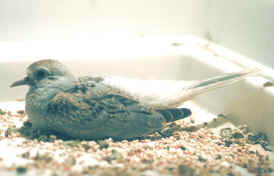 Day 19July 12, 2007
The second egg was laid in the afternoon. Baby helps with incubation but slept with the father on the perch.
Length: 15 centimeters
Weight: 27 grams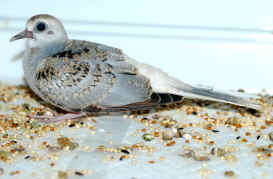 Day 20
July 13. 2007
When the cage door is left open goes out and eats cheese, noodles and bread with the other birds. Peeps while flying. Explores room and wanders on carpet. Rarely seen begging for food anymore. Continues to return to the cage to sleep with the parents.
Length: 16 centimeters
Weight: 28 grams
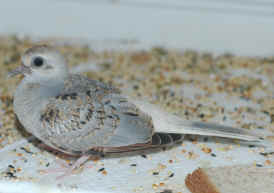 Day 21July 14, 2007
No change. Sleeps on perch with father and helps with egg incubation
Length: 16 centimeters
Weight: 27 grams (note decrease)